
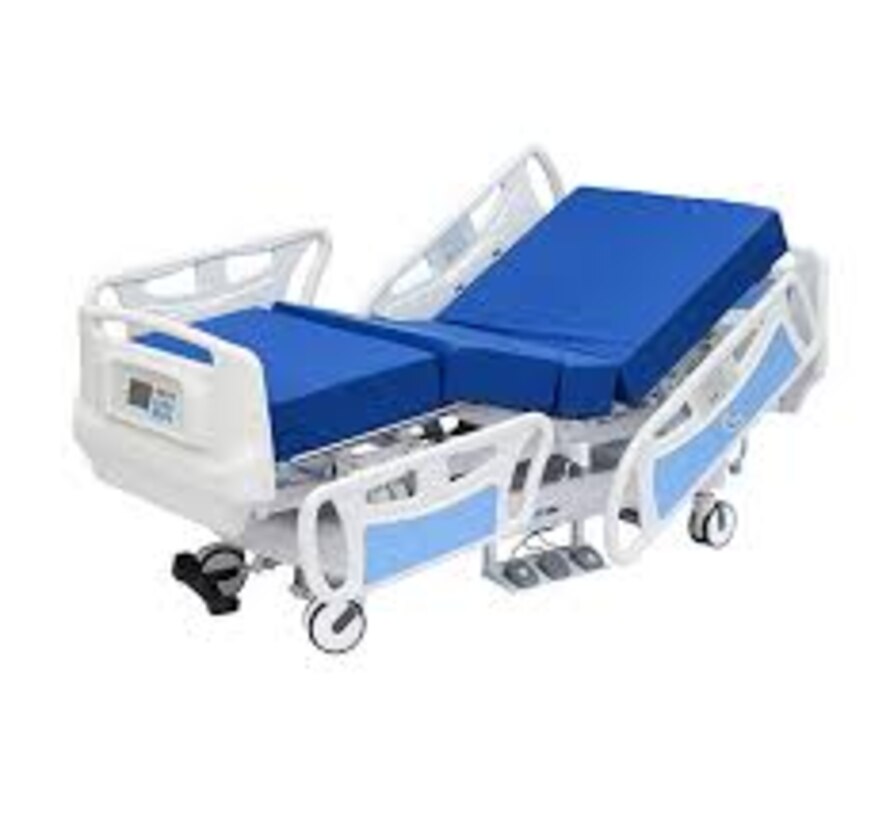
The right cot must fit the patient, mattress, room and care routine at the same time; a suitable-looking frame can still create transfer, entrapment or electrical-safety problems. Use the checks below to compare cot types, verify the five functions, inspect the complete bed system and confirm that it will work safely in its intended setting.
Key takeaways
- Confirm patient weight, height, cot dimensions and the room’s access route.
- Match cot functions to transfers, repositioning, cleaning and emergency care.
- Check mattress size, platform limits and side-rail compatibility before purchase.
- Test every control and inspect the complete cot system before delivery.
Start with the patient, load and available space
Confirm the patient’s weight and height, the cot’s usable sleeping length and width, and the room’s access route before comparing models. A cot that fits the mattress but leaves no space for transfers, cleaning or emergency access is the wrong size.
1. Record the patient’s current body weight and height, then ask for the stated patient weight limit. Do not substitute the safe working load: that figure may include the patient, mattress, bedding, side rails, lifting pole and infusion equipment. Ask the manufacturer to state exactly what it includes, and keep the combined load below it.
2. Compare the required mattress dimensions with the platform’s length, width and permitted thickness range. On a profiling cot, confirm the mattress’s permitted bending radius and rail compatibility; a flat mattress can bunch, slide or leave gaps when the backrest rises.
3. Measure the cot dimensions in its lowest and highest positions, including rails and attached accessories. Check the bed height range against transfer needs, ceiling clearance and caregiver posture. A low position can reduce injury from a fall, while a raised position can aid transfers, but lock the castors before moving or transferring the patient.
4. Measure every part of the route: doorway width, sharp turns, lift dimensions, bedside clearance and the space needed for a wheelchair or hoist. For home use, locate electrical outlets and confirm the cot’s transport weight and whether it dismantles without specialist equipment.
Match the cot type and five functions to the care routine
Choose the operating system around who will reposition the patient, how often, and what happens if power fails. A manual hospital cot suits a stable patient with a trained caregiver and infrequent adjustments; powered models reduce bending and lifting during repeated care.
| Option | Adjustments and controls | Best fit |
|---|---|---|
| Manual hospital cot | Staff or caregiver operate cranks or levers for each movement | Reliable routine care where power is unavailable or adjustments are occasional |
| Semi-electric cot | Electric backrest and leg movement; height is usually adjusted manually | Patients needing regular upper-body positioning while a caregiver can set bed height |
| Fully electric cot | Handset-operated backrest, leg elevation, height, and tilt functions | Dependent patients, frequent repositioning, and caregivers who need safer working height |
A five-function cot provides these specific movements:
- Backrest elevation supports breathing, feeding, communication, and upper-body care.
- Knee or leg elevation reduces sliding and supports comfort during rest or procedures.
- Height adjustment brings the platform to a safe level for transfers, dressing, wound care, and cleaning.
- Trendelenburg tilts the head lower than the feet for selected emergency or procedural uses directed by trained clinicians.
- Reverse Trendelenburg raises the head above the feet for positioning and selected clinical procedures.
If the backrest rises, request a clearly accessible CPR release or rapid-flat function. Confirm that it works during mains-power loss and ask whether a charged battery backup is supplied. For any powered cot, check cable routing, liquid protection, emergency lowering, battery-status indication, replacement parts, and conformity with IEC 60601-2-52.
Test the brakes on the actual floor; lockable castors alone do not prove stability during lateral transfers.
Check mattress, platform and side-rail compatibility
Treat the frame, mattress, platform and rails as one bed system. Mattress compatibility prevents a short, narrow or excessively thick mattress from leaving gaps, rising above the rail, or sliding when the backrest or knee section moves.
Before accepting the cot, check:
- Measure the mattress length, width and thickness against the manufacturer’s stated range. Confirm the permitted bending radius for an articulating frame.
- Match the mattress to a split mattress platform. A standard flat mattress can bunch at the hinges, slide toward the foot end or open a gap when the sections elevate.
- Verify that the mattress remains secured at every position, including maximum backrest and knee elevation. Test this with the mattress fitted, not on an empty frame.
- Confirm that full-length side rails are designed for that frame and mattress thickness. A rail that stops below the mattress top can permit a roll-out; one that sits too high can encourage climbing.
- Inspect the FDA’s seven bed-rail entrapment zones, including spaces within the rail, between rail and mattress, and between the mattress and headboard or footboard. Measure any gap against the cot manufacturer’s limits.
- Do not treat rails as automatic fall prevention. For a person with confusion, weakness, seizures or a falls history, obtain a qualified clinical risk assessment; bed-rail entrapment and climbing injuries require different safeguards.
Operate each rail through its full movement and lock it firmly. Reject the combination if a rail catches, leaves a visible gap, compresses the mattress edge or becomes removable without the intended release.
Inspect controls and position the cot safely for care
Before the first transfer, run every powered movement with the cot empty, then repeat it with the intended load. A control fault can leave the backrest raised or the cot stranded at an unsafe height.
1. Test height, backrest and leg movements from the handset. Confirm that each button stops when released, the handset lockout disables unauthorised movement, and cables stay clear of castors, hinges and pinch points.
2. Test locking castors on the actual floor, not only in the showroom. Apply the brakes, push the cot from each side, and check that it remains stable during a lateral transfer; wheel locks do not always equal a central-braking system.
3. Locate and operate the emergency lowering or CPR release. Confirm that it rapidly flattens the backrest during mains failure, and ask whether battery backup powers that function.
4. Check the battery status indication, mains lead and charging connection. Ask how long the battery supports adjustments and where replacement batteries, handsets, motors and fuses come from.
5. Keep liquids away from the handset, sockets, motors and control box during wound care or cleaning. Route the power lead where it cannot be trapped, pulled or run through standing water.
6. Raise the cot for caregiver work, lower it for recovery and lock the castors before leaving the patient. Do not leave a confused, weak or seizure-prone user to operate rails or controls without a qualified clinical assessment.
Verify the complete bed system before delivery
Before signing the delivery note, document the cot’s model, serial number, safe working load, mattress specification, included rails and accessories, warranty, assembly requirements, and service contact. Request the manufacturer’s conformity information for IEC 60601-2-52 and retain the operating, cleaning and emergency-release instructions.
1. Run every powered movement with the supplied mattress: backrest, leg section, height range, Trendelenburg and reverse Trendelenburg. Confirm that controls stop when released and that the emergency CPR release flattens the backrest.
2. Unplug the cot and test the CPR release again. Record whether it works without mains power, how long the battery supports operation, and whether a battery is included rather than assumed.
3. Fit the specified mattress and rails, then inspect every edge for gaps, pinch points and movement during profiling. Check that the mattress thickness, bending limit and rail positions match the frame.
4. Test castor brakes on the actual floor, not only in the showroom. Confirm whether the cot has individual wheel locks or central braking, and push it during a lateral-transfer simulation.
5. Inspect the delivered frame for damage, verify that accessories are present, and demonstrate cot cleaning without trapping fluid in joints or controls.
Ask Rajendra Surgicals, or any home-care equipment supplier, to record these results on the invoice or medical bed inspection form; photographs of the serial plate and accepted configuration help resolve later service disputes.
Related products
 | Hospital Equipment Hospital Cot A Hospital Cot is a specially designed medical bed used to provide comfort, safety, and proper support for patients during treatment or... View product → |
 | Hospital Bed Base 5 Function Electric Cot A Base 5 Function Electric Cot is an advanced hospital bed designed to provide maximum comfort, safety, and convenience... View product → |
Frequently asked questions
How do I choose the right hospital cot size?
Confirm the patient’s weight and height, usable sleeping length and width, and the room’s access route. Leave space for transfers, cleaning and emergency access.
Which hospital cot functions should match the care routine?
Match the cot type and five functions to the patient’s needs, including transfers, repositioning, cleaning and emergency care.
What should I check before buying a cot mattress and side rails?
Verify that the mattress fits the platform, supports the cot’s load limits and is compatible with the side rails. Check that the rails operate without creating unsafe gaps.
How can I verify a hospital cot before delivery?
Inspect the complete bed system, including the frame, mattress, platform, side rails, controls, castors and accessories. Test each function and confirm the cot fits the intended care space.