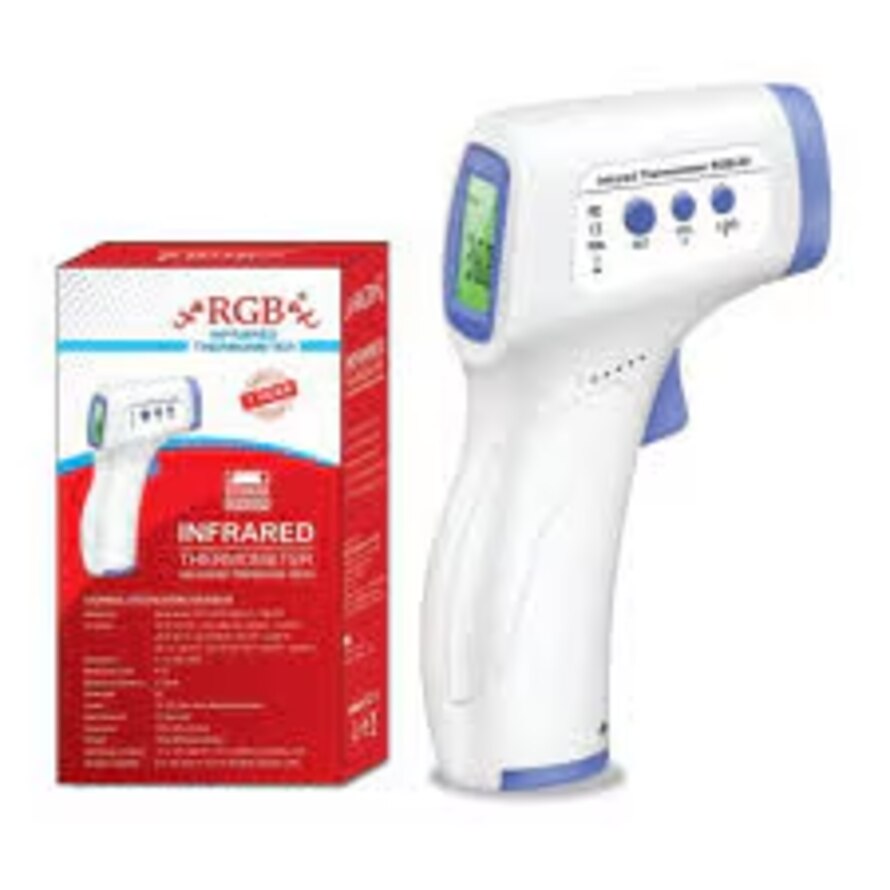
A forehead scan is convenient, but its result depends on the skin site, room conditions, distance, and operating mode. By the end, you will know how infrared thermometers detect heat, how to take a dependable reading, when to repeat it, and which features matter before you buy.
Key takeaways
- Scan the forehead from the distance specified in the thermometer manual.
- Wait indoors after exercise, bathing, or exposure to hot or cold weather.
- Repeat the reading when sweat, hair, hats, or drafts affect the forehead.
- Compare infrared, oral, axillary, ear, and rectal methods before choosing.
How infrared thermometers turn skin heat into a quick reading
A non-contact infrared thermometer detects infrared radiation emitted by the skin over the forehead or temporal region and converts that heat signal into a temperature estimate. That forehead temperature scan measures the surface, not the temperature inside the body, so it is not automatically equal to an oral, rectal, axillary, or core-temperature measurement.
The practical benefits of contact-free temperature checks include:
- Rapid screening when you need to identify a possible elevated temperature quickly.
- Less disturbance for a sleeping patient because the check can be quiet and brief.
- No probe placed in the mouth, ear, or rectum.
- Reduced skin contact and less probe-sharing between successive users.
- Easier checks for children, people who cannot cooperate with oral measurement, and patients in isolation.
How infrared thermometers work does not make every displayed number a diagnosis. A forehead reading can miss illness after fever-reducing medicine or when the scan is poorly performed, so use it to flag a possible concern rather than to interpret one isolated number as proof of fever.
Contact-free does not mean maintenance-free. Clean the sensor according to the manufacturer’s instructions, keep the lens clear, and select body-temperature mode—not object or surface mode—before measuring. Use the device within its stated conditions; the wrong mode can produce a plausible-looking reading with the wrong meaning.
How to take a dependable forehead reading
A dependable reading starts before you press the button. Keep the person and thermometer in the same room until thermometer acclimatization is complete after moving between markedly different temperatures. Use the device only within the manufacturer’s stated room-temperature and humidity range.
1. Select body-temperature mode, not object or surface mode.
2. Uncover the forehead and move hair away from the target area. Make sure the skin is dry; sweat, moisture, or hair can alter the surface estimate.
3. Hold the thermometer at the exact forehead measurement distance and angle given in its manual. Contact-free does not mean position-free.
4. Aim at the specified central forehead or temporal site. Keep the person still, then press the measurement button.
5. Wait for the beep, light, or other confirmation signal before reading the display. Moving the device or reading early can produce an incomplete result.
6. Record the result only after the signal confirms measurement. Follow any stated instructions about repeat readings.
Do not substitute the wrist, neck, or another forehead area unless the manual permits it. Each site has different skin exposure, blood flow, and environmental effects, while the thermometer’s calibration is built around a specified location.
Follow the model’s age, measurement-site, and intended-use restrictions; a device designed for adults or forehead checks does not automatically suit every child, patient, or body site.
What makes an infrared reading unreliable, and when should you repeat it?
A scan becomes unreliable when the forehead or the surrounding environment changes the skin’s surface temperature. Common infrared thermometer errors include sweat and forehead temperature changes after bathing, exercise, heat, or cold exposure.
| Error | Why it affects the result | Correct it before repeating |
|---|---|---|
| Sweat, hair, heavy cosmetics, hats, or head coverings | Blocks or alters the forehead’s emitted heat | Dry and uncover the target area |
| Recent bathing or exercise, direct sunlight, drafts, or a cold room | Warms or cools the skin unevenly | Move away from the exposure and allow the person and device to stabilise |
| Incorrect distance, an oblique angle, movement, or a dirty sensor lens | Prevents the sensor from reading the intended area accurately | Follow the manual’s distance and angle; hold still and clean the lens as instructed |
Pause instead of taking several scans from the same faulty position. Repeat temperature measurement only after the person and device are stable, the forehead is dry and uncovered, and the correct distance and body-temperature mode are restored.
- Repeat an unexpectedly high, low, or symptom-inconsistent result.
- Compare readings taken under the same conditions; do not treat the highest or lowest number as definitive.
- Record the time, site, device, and relevant symptoms.
- When the result affects a care decision, check it with a suitable contact digital thermometer or another clinically validated method.
Good temperature reading accuracy does not make a normal forehead result proof that illness is absent. Fever-reducing medicine or a poorly performed scan can produce a normal reading despite symptoms.
How infrared checks compare with oral, axillary, ear, and rectal methods
Choose an infrared forehead check when speed, comfort, and minimal disturbance matter more than the consistency of a contact site. It is quick and quiet, while an oral reading needs correct mouth placement and cooperation.
| Method | What the check demands | Main trade-off |
|---|---|---|
| Infrared forehead | Correct distance, angle, mode, and a clean, dry forehead | Fast and comfortable, but measures a skin site |
| Oral | Probe under the tongue with the mouth closed | More consistent placement, but unsuitable for an uncooperative or sleeping person |
| Axillary and tympanic temperature | Probe positioned in the armpit; ear thermometer aligned with an unobstructed canal | Comfortable, but positioning errors alter results |
| Rectal | Lubricated probe inserted at the rectum using safe technique | More invasive, but represents a different measurement site |
Contact digital thermometers need probe cleaning or a disposable cover between users. Infrared devices reduce probe-sharing and cross-contact work, but their sensor still needs care according to the manufacturer’s instructions.
Forehead, oral, axillary, tympanic, and rectal temperatures have different expected values. Do not apply one fever cutoff to every site, device, and population; interpret the number with the measurement site and clinical situation.
For medical use, check the stated intended use, accuracy information, operating range, and compliance with the ISO 80601-2-56 thermometer standard or ASTM E1965. A display showing hundredths of a degree does not prove equivalent clinical accuracy.
Which infrared thermometer features are worth comparing before you buy?
An infrared thermometer buying guide starts with intended site, not the biggest display or fastest scan claim. Compare a forehead versus ear thermometer against your routine: repeated checks on sleeping children favour forehead use, while ear models require correct alignment and an unobstructed ear canal.
| Measurement site | What to compare | When it fits |
|---|---|---|
| Forehead | Temporal or central-forehead use, stated distance, age limits | Quiet checks for children, sleeping patients, and caregivers |
| Ear | Tympanic use, probe angle, ear-size restrictions, disposable-cover needs | Users who can tolerate correct ear positioning |
| Both | Body-temperature mode, operating range, accuracy, cleaning method | Choose only if the manual permits your intended patients |
Check these purchase details before choosing:
- Look for Celsius/Fahrenheit switching, fever alert and memory storage, silent mode and backlit display, and clear distance guidance.
- Confirm response time, battery type, access to the compartment, and how replacement batteries are fitted.
- Require explicit sensor-cleaning instructions. A missing cleaning method is a practical disqualifier.
- Prefer a stated operating range and accuracy specification over hundredths on the screen or an extreme scan-speed claim.
- Confirm separate body-temperature and object-temperature modes; surface mode is not for patient readings.
- For medical use, check age restrictions and recognised standards such as ISO 80601-2-56 or ASTM E1965.
In Bengaluru, Rajendra Surgicals can help you ask about intended use, cleaning, batteries, warranty documents, and suitability for children, older adults, or repeated caregiver checks. Choose for the measurement situation, not convenience alone.
Related product
 | Oxee check pulse oxemeter An Oxee Check Pulse Oximeter is a compact and reliable medical device used to measure blood oxygen saturation (SpO₂) and pulse rate quickly and... View product → |
Frequently asked questions
How does an infrared thermometer measure temperature without touching the skin?
It detects infrared radiation from the forehead or temporal region and converts the surface heat signal into a temperature estimate.
How do you take a dependable forehead temperature reading?
Use the thermometer at the distance stated in its manual, scan clean exposed skin, and keep the device aligned with the forehead.
When should you repeat an infrared thermometer reading?
Repeat it when sweat, hair, hats, drafts, direct sunlight, recent exercise, bathing, or hot and cold surroundings could affect the result.
How does an infrared reading compare with oral, axillary, ear, and rectal methods?
Infrared thermometers measure skin surface temperature, while oral, axillary, ear, and rectal methods measure different sites with different accuracy, timing, and handling requirements.
Which infrared thermometer features are worth comparing before buying?
Compare the stated measuring distance, response time, display readability, memory, fever alerts, measurement modes, battery type, and cleaning instructions.