A folding walker is useful only when you can control its frame, bear the needed weight through your arms, and use it on the surfaces and routes you face each day. You will be able to match the walker style to your mobility, set its height, fold and store it safely, and recognise when professional fitting or a different aid is needed.
Key takeaways
- Choose a walker you can advance without losing balance or control.
- Set every leg adjustment so both handles sit at the correct height.
- Lock folding joints and check rubber tips before each walk.
- Seek professional training if you cannot grip, stand, or bear weight safely.
Is a folding walker suitable for your mobility needs?
Folding walker suitability depends on your ability to control the frame, not simply on whether it folds. You need to stand upright, grip both handles securely, use weight-bearing through arms without pain, and advance the walker without losing balance or control.
Use this quick screen:
- Can you maintain an upright posture while standing in your usual shoes?
- Does your grip strength let you hold both handles without your hands slipping or tiring quickly?
- Can you lift or push the frame forward while keeping your feet stable?
- Can you stop, turn, and bring your body safely into the frame?
If you answer no to any point, arrange a mobility assessment with a physiotherapist or clinician before relying on the walker. Get assessed promptly if you have recently become dependent on a walker, fall repeatedly, cannot steer it, or become dizzy or short of breath while walking.
A standard pick-up walker gives stronger braking stability but requires lifting, which can strain weak arms or painful shoulders. A two-wheeled walker rolls more continuously but demands better control. A rollator is intended for rolling support rather than substantial weight-bearing through the arms.
Check the walker’s published weight rating, including your body weight and any bag or oxygen equipment. Set the handles at your wrist creases while standing upright; your elbows should bend about 15–30 degrees when holding them.
Which walking frame matches the way you move?
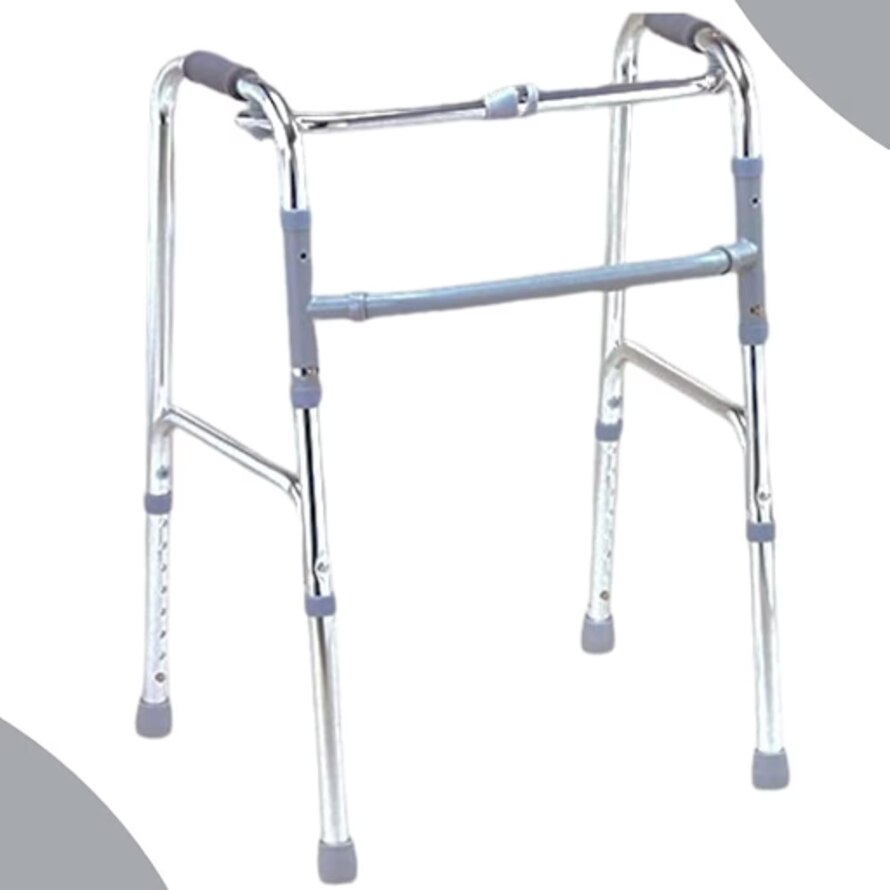
A standard pick-up walker gives the most braking stability because all four legs stay planted, but you must lift and advance it. That suits someone who needs substantial unloading of a weak leg and can lift without painful shoulders or poor coordination.
| Option | Practical difference | Best fit |
|---|---|---|
| Standard pick-up walker | Four rubber tips; no rolling. Move it forward, set all legs down, then step. | Maximum stability and substantial weight support |
| Two-wheeled walker | Front wheels reduce lifting and allow a smoother stride; the rear tips still provide braking. | Someone needing leg support who can control forward movement |
| Four-wheeled rollator | Rolls continuously and usually has hand brakes, a seat and a storage bag. It is not designed for maximum weight-bearing. | Someone who mainly needs balance support and can brake and steer reliably |
| Wheeled walking frame | A general term covering frames with wheels; check whether it has two or four, plus the brake system. | Choose by the wheel layout and your ability to control it |
A rolling frame is a poor match if you lean heavily through your arms, cannot squeeze the brakes, or lose control when the frame moves ahead. A pick-up walker is a poor match when lifting it causes shoulder pain or you cannot coordinate each advance.
When comparing models at Rajendra Surgicals, check the total weight rating, including a bag or oxygen equipment, and confirm that tips, glide caps, wheels and handgrips match the frame.
Related product
 | walker ₹1900 Walker A Walker is a supportive mobility aid designed to assist individuals who have difficulty walking due to age, injury, surgery, or physical... View product → |
How do you adjust, fold, transport, and store the frame?
Set the walker handle height while you stand upright in your usual shoes. Let your arms hang relaxed: each handgrip should meet your wrist crease. After gripping the handles, your elbow bend should remain slight, usually about 15–30 degrees.
A low frame encourages stooping and shoulder strain; a high frame reduces your ability to press down for support.
Use the folding release mechanism only while the frame is stationary and unloaded. Follow the model’s instructions, because some walkers use buttons and others use levers or pull cords.
1. Move the walker into an open area before folding it. Keep fingers clear of the joints, press or pull the release, and collapse the sides without forcing them.
2. Place the folded frame in the car’s boot or another space where it cannot slide under the pedals or strike a passenger. Do not use a folded walker for support, and do not leave loose accessories where they can be lost.
3. For storage beside a bed or in a narrow hallway, fold the frame fully and stand or lay it where it cannot block the walking route, doorway, or emergency exit.
4. Before every use, unfold the frame until each joint or release button fully locks. Push gently against the handles and check for rocking, a bent tube, missing fastener, or failed lock; do not use it until repaired. Keep model-compatible rubber tips, glide caps, wheels, and handgrips fitted securely.
How do you use a walker safely around the home?
Use this sequence for standard walker technique: move the frame only as far as you can control, keep all four legs or wheels stable, and step into—not beyond—the frame. Step first with your weaker leg, then bring the stronger leg forward; do not lean your chest over the front bar.
1. Start walking by standing tall, gripping both handles, and advancing or rolling the walker a short distance. Pause until it is stable before taking your steps.
2. For turning with a walker, make several small steps and turn the frame with you. Do not twist your body, pivot on one foot, or swing the walker around while your feet stay still.
3. For a sit-to-stand transfer, place the walker in front of you, push from the chair’s armrests or seat, and stand fully before grasping the handles. To sit, back up until your legs touch the chair, reach back, and lower yourself slowly; never pull up on the walker.
4. Approach thresholds and stairs slowly. Square the walker to a low threshold, lift or roll it over without rushing, and check that each leg or wheel has cleared it before stepping.
Do not use a walker on stairs like a cane; stop and get physiotherapy instruction, because a handrail and another aid may be safer.
5. Treat wet, loose, or uneven flooring as a stop signal. Dry spills, remove small rugs and cables, and ask for help rather than forcing the frame across a surface that catches or slides.
What should you check before walking, and when do you need training?
Before every walk, a walker safety inspection should take less than a minute and should end with a controlled test beside a stable surface.
- Check each tube for bends, cracks, loose screws, missing fasteners, or rocking. Do not use a damaged frame.
- Press each folding release and confirm the folding joints lock completely. A frame that opens or rattles during loading can collapse.
- Examine the rubber tips, glide caps, wheels, and handgrips. Replace worn, split, uneven, loose, or model-incompatible parts; a damaged tip can catch or slide.
- Put weight through the handles while standing still. Stop if the frame shifts, a wheel runs unevenly, or a joint clicks out of position.
- Take a few steps on a clear, dry floor. Seek physiotherapist gait training if you lift the frame incorrectly, lean heavily, drag a foot, lose balance, or cannot turn and stop smoothly.
You may need a different aid when a rollator runs away from you, when you cannot control its brakes, or when a standard walker does not provide enough unloading for a weak leg. Do not use the walker on stairs without individual instruction; a handrail or another aid may be safer.
Repeated near-falls call for broader fall-prevention support: strength and balance exercise, medication review, vision testing, suitable footwear, and removal of loose rugs or poor lighting.
Frequently asked questions
Is a folding walker suitable for your mobility needs?
A folding walker suits you when you can stand upright, grip both handles securely, bear weight through your arms without pain, and advance the frame without losing balance or control.
Which walking frame matches the way you move?
Choose a standard frame for maximum stability, a two-wheel walker when lifting is difficult, or a rollator when you can control wheels and need continuous movement.
How do you adjust, fold, transport, and store the frame?
Set the handles near wrist level when standing upright with relaxed shoulders, confirm each leg pin is engaged, lock folding joints before use, and store the folded frame where it cannot fall.
How do you use a walker safely around the home?
Clear loose rugs and cables, keep the frame close, move it a short distance before stepping, and avoid pulling up from the walker or carrying objects while walking.
What should you check before walking, and when do you need training?
Check handle height, leg pins, folding locks, frame stability, and rubber tips before walking. Ask a physiotherapist for training if balance, grip, pain, or weight-bearing control is limited.