Leakage often comes from poor fit, folded barriers, delayed changes or a product that cannot handle the wearer’s movement and output—not simply from insufficient absorbency. You will be able to compare construction, choose the right style and size, apply it correctly, and protect the wearer’s skin.
Key takeaways
- Choose full-coverage protection for bowel incontinence.
- Match absorbency to the wearer’s daily routine and fluid output.
- Measure the waist and hips before selecting a diaper size.
- Clean and dry skin fully after every change.
How the construction controls leakage
Leakage control depends on three jobs: move liquid away from the skin, lock it inside the absorbent core, and seal the waist and legs. A urine-focused pad may absorb urine but fail with liquid stool, so bowel incontinence requires full coverage and secure barriers.
| Construction feature | What it does | What it cannot do |
|---|---|---|
| Absorbent core and superabsorbent polymer | Hold urine and reduce rewetting | Prevent leakage after saturation or very rapid fluid arrival |
| Acquisition and distribution layer | Pull fluid from the surface and spread it across the core | Replace a core with enough capacity |
| Standing leak guards and elastic leg cuffs | Direct urine and liquid stool inward and reduce side escape | Seal gaps caused by poor size or incorrect application |
| Waist barriers | Limit escape at the back and waist during sitting or movement | Compensate for a loose or over-tight fit |
| Breathable backsheet | Lets water vapour escape, reducing heat and humidity | Let urine pass through or remove the need for timely changes |
| Wetness indicator and odour control | Show that wetness is present and reduce smell | Measure remaining capacity, discomfort, or stool |
After applying the product, pull the standing leak guards and elastic leg cuffs out from the folds. Check that they lie flat against the skin; a saturated core, shifted diaper, or gaps at the waist and legs will defeat good materials. Choose by waist and hip measurements, not body weight alone.
Choose the style and absorbency for the wearer’s routine
Choose the style by how the wearer moves and gets changed, not by absorbency wording. Pull-on pants suit someone with enough mobility to stand, balance and manage dressing. Taped adult diapers work better for bed changes, repositioning, transfers, caregiver assistance or bowel incontinence because you can open them without pulling clothing down.
| Option | Best fit | What to judge |
|---|---|---|
| Taped adult diapers | Bed changes, transfers and overnight use | Secure fastening after repositioning; check the core size and leg seal |
| Pull-on pants | Standing, walking and independent dressing | Easy movement without sagging; change access becomes harder when the wearer cannot stand |
| Daytime | Regular urine volumes with planned changes | Acquisition speed and comfort during movement, not the word “day” |
| Overnight use | Longer wear between checks | Retention capacity, low rewet under pressure and leakage performance during sleep |
| High absorbency | Larger volumes or longer intervals | Evidence that the product handles the wearer’s volume; “maximum” alone proves nothing |
Absorbency is not one standardized consumer measure. Compare how quickly the core takes in fluid, how much it retains, and how much moisture returns to skin when compressed. A wetness indicator shows wetness, not remaining capacity or the presence of stool.
When comparing options at Rajendra Surgicals, ask whether a booster is designed for that outer brief; an ordinary pad can block the acquisition layer and cause side leakage. Repeated leaks can indicate a wrong size, folded cuff, saturated brief or poor match for the wearer’s mobility—not a need for higher absorbency.
Related products
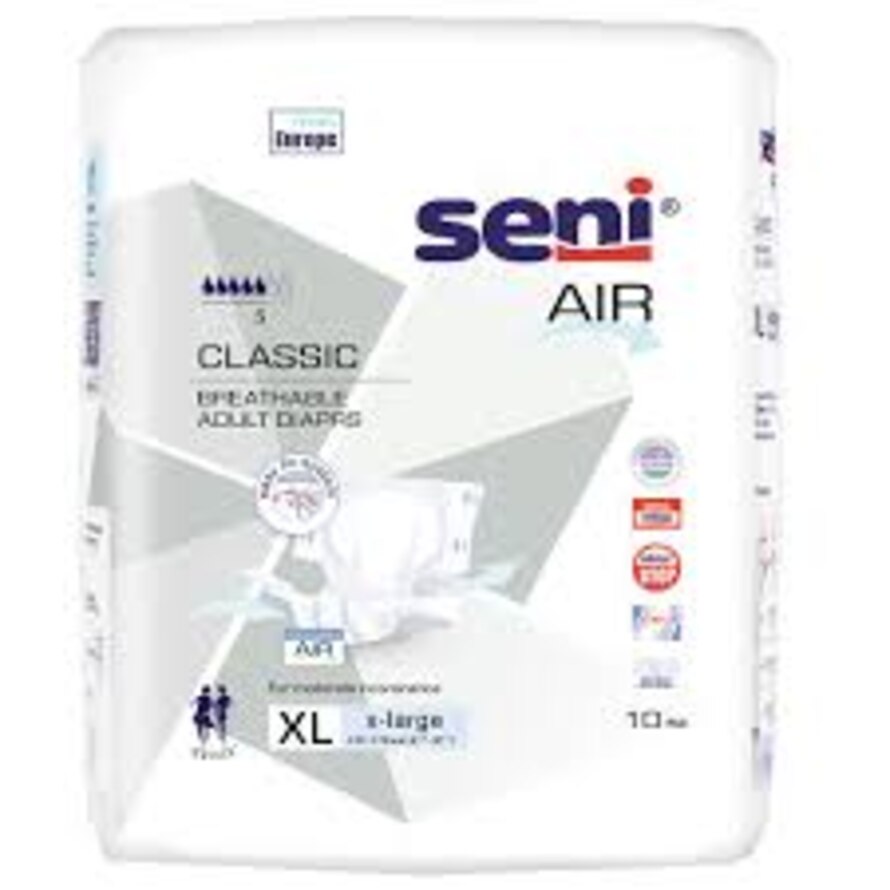
 | Seni Adult diaper Seni Adult Diapers are high-quality disposable hygiene products designed to provide reliable protection and comfort for adults experiencing urinary... View product → |
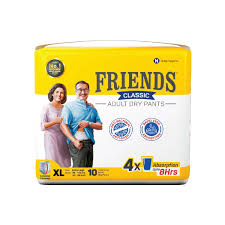 | Friends Adult Dry pants Friends Adult Dry Pants are specially designed disposable diaper pants that provide reliable protection and comfort for adults experiencing urinary... View product → |
Measure the body and create a secure fit
Measure the waist circumference and hip circumference with the wearer standing, if safe, and keep the tape level without pulling it tight. Compare both numbers with the product’s size chart.
If they fall in different size ranges, choose the larger measurement; a small brief compresses the absorbent core and leaves gaps when the wearer sits or walks.
After applying it, run this fit check:
- The waist sits close against the body without digging in, rolling, or leaving a visible gap.
- The leg openings lie flat against the skin without pinching, red pressure marks, or loose spaces.
- Pull the elastic cuffs and standing inner barriers outward from the inside of each leg opening. Folded-in barriers create a path for side leakage.
- Ask the wearer to sit, stand, walk, or transfer if possible. Watch for shifting, gaping, or the brief sliding down.
- Check that fastening tabs hold the brief securely without overlapping so tightly that movement is restricted.
A secure fit feels snug, not tight. If urine escapes despite an unsaturated brief, inspect the size, waist seal, leg openings, and pulled-out barriers before choosing greater absorbency. Repeated leaks during movement can mean the brief does not suit the wearer’s body shape or mobility.
Do not add an ordinary pad or liner inside to fill gaps; it can block the acquisition layer and worsen leakage.
Apply, remove and change the product correctly
Use pull-on pants for someone who can stand and help with dressing; use taped briefs when a caregiver is changing the wearer in bed, during transfers, or after fecal soiling. Choose a standing application or lying-down application based on safety and mobility, not convenience alone.
- For a lying-down application, roll the brief lengthwise, position the rear panel under the hips, and pull the front panel between the legs. Keep the absorbent core centring aligned with the genital area.
- For a standing application, open the taped brief fully, support the wearer while they step into or stand over it, then bring the front panel up evenly.
- Pull elastic leg cuffs and inner barriers outward. A folded cuff creates a leak path.
- Fasten symmetrical fastening tabs at the waist, checking that the side seams sit flat and the leg openings touch the skin without pinching or gaps.
- Pull on pants up to the waist, smooth the front and back, and check the cuffs after the wearer walks or sits.
- To remove a taped brief, release the tabs, fold the soiled surface inward, and roll it closed. Do not pull a wet brief across the skin.
Change timing depends on wetness, odour, comfort, skin condition and the wearer’s output. Change immediately after fecal soiling, even when urine capacity remains. A wetness indicator signals moisture, not remaining capacity or comfort; replace a saturated product rather than waiting for a leak.
Repeated leakage calls for checking size, fit, cuffs and application before simply choosing higher absorbency.
Protect the skin after every change
After every change, remove urine and stool promptly; stool exposure is generally more irritating than urine exposure. Gentle cleansing with lukewarm water and a fragrance-free cleanser lifts residue without stripping protective oils, while aggressive rubbing damages fragile skin. Pat dry, including skin folds: drying reduces moisture that softens skin and worsens incontinence-associated dermatitis.
Apply a thin barrier cream or other skin protectant to clean, dry skin around the buttocks, groin and perineum. Zinc oxide or dimethicone forms a film against urine exposure and stool exposure. A thick layer makes the next inspection and cleaning harder. Do not apply cream over broken skin unless a clinician recommends that product.
| Skin finding | Immediate action | Seek clinical advice when |
|---|---|---|
| Mild redness | Clean, dry and protect at each change | It lasts beyond 24–48 hours or spreads |
| Broken skin, weeping or bleeding | Stop rubbing and prevent further soiling | Promptly, because it needs assessment |
| Fungal rash | Keep the area dry and ask before using an antifungal | It has sharp edges, satellite spots, or does not improve |
| Pressure marks | Check the fit and remove the pressure source | A mark remains, blisters, or turns purple |
Pain, warmth, swelling, pus, fever or rapidly worsening redness needs prompt medical attention. A suspected fungal rash or pressure injury needs clinical advice rather than repeated barrier cream alone.
Frequently asked questions
How do adult diapers control leakage?
They move liquid away from the skin, hold it in an absorbent core, and use waist and leg barriers to reduce leaks.
Which adult diaper style and absorbency should you choose?
Choose the style based on mobility and changing needs, then match absorbency to the wearer’s routine and output. Use full coverage for bowel incontinence.
How do you get a secure fit?
Measure the wearer’s body according to the product instructions and fasten the diaper snugly without gaps, pinching, or excessive pressure.
How should you protect skin after changing an adult diaper?
Remove soiling gently, cleanse the skin, dry it completely, and apply a suitable barrier product when needed.