Comfort depends on more than motor power: the wrong seat dimensions, control position, battery estimate, or turning footprint can make everyday trips tiring and unsafe. By the end, you will have a practical checklist for matching the chair to the user, the home, the route, and the assistance available.
Key takeaways
- Test joystick access from the user’s normal seated posture.
- Measure doorways, turning spaces, ramps and transfer areas before buying.
- Estimate battery range from real routes, slopes, load and charging access.
- Choose pressure-relieving seating and suspension suited to daily surfaces.
Start with control access, braking, and low-speed safety
Reliable control starts with a joystick placement that lets the user steer without leaning forward or holding the shoulder raised. Check operation from the actual seating position, including turning, reversing, and reaching the drive control without losing posture.
| Option | How it behaves | When it fits |
|---|---|---|
| Proportional control | Joystick movement produces gradual changes in speed and direction | Users who can make controlled hand or finger movements |
| Non-proportional control | Each direction selects a preset movement or speed | Users who struggle to grade joystick pressure |
| Attendant control or alternative input | A caregiver, chin control, head array, or sip-and-puff system operates the chair | Users who cannot reliably use a standard joystick |
Ask for speed settings and programming limits that restrict acceleration, top speed, reverse speed, and turning response indoors. A high top speed is useless if the chair surges, stops late, or cannot manoeuvre around furniture.
- Electromagnetic brakes should stop the chair when the joystick is released; test stopping on the user’s usual slope, not only on level flooring.
- Anti-tip wheels reduce rearward tipping but can catch on kerbs and reduce obstacle clearance, so match their position to local routes.
- Power seat elevation helps with transfers and reaching, but raising the seat lifts the centre of gravity. Check stability on the intended slopes and uneven surfaces with the user seated.
Measure the person, chair, and home before comparing models
A chair that fits the body can still fail at the bathroom door, dining table, or elevator. Measure the person, the chair, and the routes before comparing features or finishes.
1. Measure the seated user on a firm, level surface. Record seat width across the hips and thighs, seat depth from the back of the pelvis to just behind the knees, backrest height, footrest length, and armrest height. Check pelvic position, thigh support, foot placement, and the person’s weight against the chair’s maximum user weight.
Excess width reduces trunk stability; insufficient width creates hip pressure.
2. Measure the chair’s overall width, seat-to-floor height, turning dimensions, and length with footrests fitted. Compare those figures with every doorway’s clear opening, bathroom approach, elevator interior, table height, threshold, ramp, and storage or charging space. Measure with doors open and closed where both affect access.
3. Mark the chair’s footprint on the floor using tape and practise the tightest turn, transfer, and reach. Include the user’s hands, feet, and any attendant walking beside the chair. A model that clears a doorway may still leave no room to align beside a toilet or bed.
4. Test power seat elevation with the user seated. Raising the seat changes the centre of gravity, so check stability on the actual slopes and surfaces the person will use rather than choosing by maximum lift height alone. Recheck armrest and table clearance at both the lowest and raised positions.
Compare battery range using real daily conditions
Treat the advertised range as a laboratory comparison, not a promise. Compare figures measured under the same method, such as ISO 7176-4, then retain enough charge for the return trip. User and chair weight, hills, rough surfaces, frequent stops, cold weather, low tyre pressure, battery age, and powered seating functions all reduce distance.
Battery chemistry affects weight, service life, charging, and replacement cost. Lead-acid batteries cost less but weigh more; lithium-ion batteries reduce weight and often provide more usable energy, but require the correct charger and cost more to replace. Ampere-hours are meaningful only alongside voltage: compare watt-hours, not ampere-hours alone.
Battery choice should also fit your routine. Check the stated charging time, charging location, socket access, and whether a removable versus fixed batteries arrangement works for your home. A removable pack helps when the chair must stay outdoors or near a stair, while a fixed pack suits a dedicated indoor charging point.
Drive layout changes the same route in different ways:
| Drive design | Indoor behaviour | Outdoor compromise |
|---|---|---|
| Mid-wheel | Small turning footprint | Front and rear casters need careful threshold handling |
| Front-wheel | Footplate area swings during turns | Can approach some obstacles differently |
| Rear-wheel | Predictable straight tracking | Often needs more turning space indoors |
Before accepting a range claim, test the loaded chair on your actual route and record:
- Distance, slopes, thresholds, surface type, stops, and weather
- Battery percentage before and after the trip
- Charging access and time needed before the next outing
Choose seating and suspension features that support the body
Comfort starts with correct seat dimensions and coordinated positioning features. Measure seat width so the pelvis stays stable without hip pressure, and choose seat depth that supports the thighs without pressing behind the knees. A pressure-relieving cushion redistributes load, but it cannot correct a seat that is too wide, narrow, or long.
Match the cushion to skin integrity, sensation, pelvic stability, transfer ability, and the user’s ability to perform pressure relief.
Compare these functions together rather than choosing the most adjustable-looking chair:
| Feature | Main benefit | Positioning risk |
|---|---|---|
| Adjustable back angle | Changes trunk support for posture and activities | A poorly chosen angle can increase pelvic sliding |
| Reclining backrest | Opens the hip angle for rest and care | Recline without matching tilt can create shear and forward sliding |
| Power tilt-in-space | Tilts the seat and back together while preserving the seated relationship | Incorrect timing or excessive tilt can hinder vision, reach, or transfers |
| Elevating legrest | Supports the legs in selected positions | Can cause pelvic sliding, behind-knee pressure, or heel contact pressure |
Choose removable or adjustable armrests and foot supports if you transfer from the side. Fixed parts can block transfers, while poor foot placement leaves the feet unsupported and affects pelvic posture. Add lumbar or lateral supports only after checking that they hold the body without pushing it out of alignment.
Suspension and pneumatic tyres can soften vibration on rough routes, but pneumatic tyres need pressure checks and can puncture. Solid tyres reduce maintenance yet transmit more vibration; suspension adds weight, cost, and maintenance, so it cannot replace suitable seating.
Match the equipment to routes, transfers, and professional assessment
Test the chair on your actual routes before buying: approach a kerb, climb the steepest ramp, cross an uneven threshold, turn in the bathroom, and enter the lift. Confirm doorway clearance, turning space, ground clearance, and charging access at home.
1. Drive over the highest kerb you will use and check whether the foot supports strike. On ramps, test stopping, reversing, and turning; a chair that manages the ascent but slides or feels unstable while descending is unsuitable.
Raise the power seat during transfers and reaching, then repeat the slope test: extra height raises the centre of gravity.
2. Practise every transfer with the intended armrests, foot supports, and cushion. Removable or swing-away parts can enable a side transfer, while fixed supports can block it. Ask a physiotherapist or occupational therapist to assess pelvic position, pressure risk, transfer technique, and whether seat elevation or tilt is safe for you.
3. Test outdoor use in shade, light rain, and poor visibility. Check the manufacturer’s water-exposure limits, then inspect lighting and reflectors before crossing roads or shared paths.
4. If you will travel seated, ask for documented wheelchair tie-down and occupant-restraint compatibility, preferably transit testing to RESNA WC19. Folding capability does not make an occupied chair crash-safe.
5. Before ordering, ask Rajendra Surgicals to arrange a practical trial and identify local servicing, battery replacement, puncture repair, and response times for faults. A professional assessment and reliable support matter more than a long feature list.
Related product
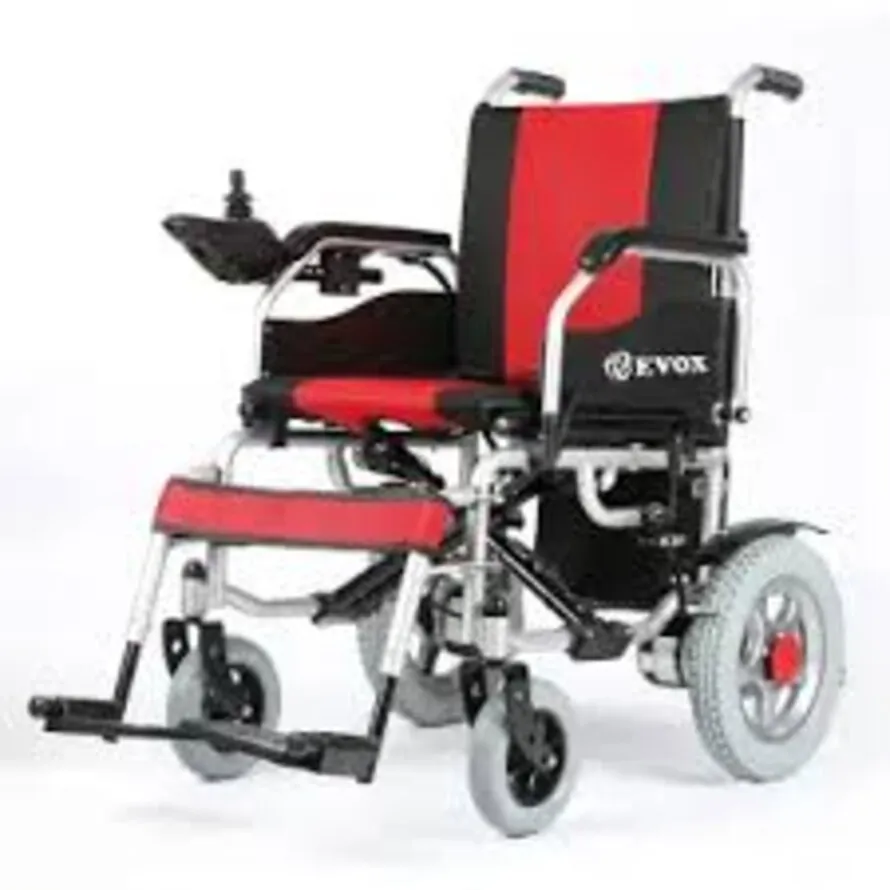
 | Electric wheel chair Electric Wheelchair An Electric Wheelchair is a motorized mobility device designed to help individuals with limited mobility move comfortably and... View product → |
Frequently asked questions
What control and braking features matter on an electric wheelchair?
Check that the joystick is reachable without leaning forward or raising the shoulder. Test forward movement, reversing and turning from the normal seated position. Look for responsive braking when the joystick is released and a low-speed setting for crowded spaces, doorways and uneven approaches.
What should you measure before comparing electric wheelchair models?
Measure the user’s hip width, leg length and seated height, then measure doorways, corridors, lifts, turning areas, ramps and transfer spaces. Compare these figures with the chair’s overall width, length, turning radius, seat dimensions and footrest position.
How do you compare electric wheelchair battery range realistically?
Base the estimate on the user’s weight, route length, hills, outdoor surfaces, stop-start driving, tyre condition and temperature. Include return journeys and confirm where the battery will be charged between trips.
Which seating and suspension features support comfortable daily mobility?
Compare seat width, depth, back support, cushion type, armrest adjustment, footrest position and pressure distribution. Suspension and larger tyres help on rough surfaces, but they can add weight and affect transport or storage.
When should a professional assess an electric wheelchair choice?
Arrange an assessment when posture, pressure injury risk, muscle weakness, transfers, vision, cognition or route safety affects operation. Match the chair to the person’s transfers, home layout, travel routes and ability to control the joystick safely.